


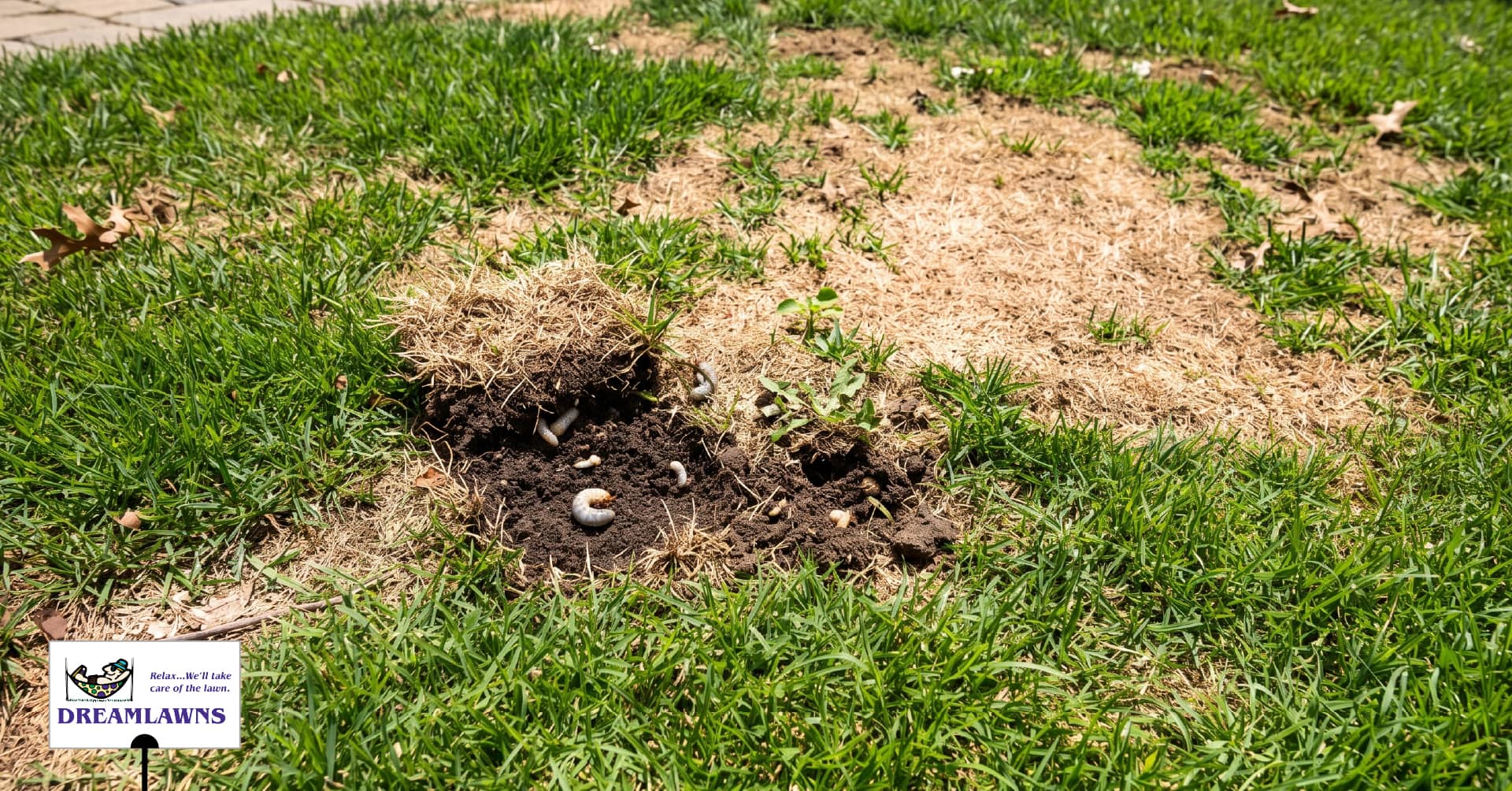
Dreamlawns Quick Cut: Grubs are the larvae of beetles that feed on grass roots, and they threaten every turf type in Virginia Beach. Damage shows up as irregular brown patches and turf that lifts easily like loose carpet, usually in late summer and fall. Timing is everything with grub control. Preventive treatments work best in early-to-mid summer when grubs are small, while curative treatments target actively feeding grubs from August into early fall. By the time severe damage appears, the most effective treatment window may have already passed.
Grubs are one of the most damaging and most commonly misdiagnosed lawn pests in Virginia Beach. They do their work underground, feeding on grass roots completely out of sight, so by the time the damage surfaces, homeowners often mistake it for drought, disease, or heat stress and treat the wrong problem entirely. Meanwhile, the grubs keep feeding.
What makes grubs especially frustrating is that they threaten every type of lawn. Whether you have Fescue, Bermuda, Zoysia, or St. Augustine, grubs feed on the roots that keep your turf alive. And because the most damaging feeding happens in late summer and fall, the window to treat effectively can close before most homeowners even realize they have a problem.
The key to protecting your lawn from grubs is understanding three things: what grubs are and how they develop, how to recognize their damage before it becomes severe, and, most importantly, when to treat.
What Are Grubs and Where Do They Come From?
Grubs are the larval stage of scarab beetles, including Japanese beetles, June beetles, and masked chafers. They’re easy to recognize once you see them: plump, C-shaped larvae, cream-colored with a distinct brown head and six legs near the front, usually about half an inch to an inch long depending on their stage of development. When you find them curled up in the soil beneath damaged turf, there’s no mistaking them.
Understanding the grub life cycle is essential, because it’s the entire basis for treatment timing. The cycle runs roughly like this:
- Summer egg-laying: Adult beetles emerge and lay eggs in the soil of lawns throughout the summer months.
- Hatching and early feeding: The eggs hatch into tiny grubs that begin feeding on grass roots near the soil surface. At this stage they’re small and cause little visible damage, but they grow fast.
- Peak feeding: As the grubs grow through late summer and into fall, their feeding intensifies. This is when visible lawn damage typically appears.
- Overwintering and pupation: As cold weather arrives, mature grubs burrow deeper into the soil to overwinter, then pupate into adult beetles the following spring to start the cycle again.
According to Virginia Cooperative Extension, the grubs are small and near the soil surface in mid-summer, which is exactly why treatment timing tied to this life cycle matters so much. Treating when grubs are small and vulnerable is far more effective than reacting after they’ve grown large and the damage is done.
Why Are Grubs a Problem for Every Grass Type?
Unlike some pests that target a specific grass, grubs feed on the root systems of all four grass types common to Virginia Beach. Roots are roots, and grubs don’t discriminate. That said, how the damage plays out does vary by grass type, largely because of how quickly each grass recovers.
- Tall Fescue: Because Fescue is a bunch-type grass that doesn’t spread to fill in damaged areas, grub-killed patches don’t recover on their own and often require fall overseeding to repair.
- Bermuda: Bermuda’s aggressive growth and deep rhizome network give it some tolerance for moderate grub feeding, and it recovers from damage faster than the other grasses, though heavy infestations still cause serious harm.
- Zoysia: Because Zoysia recovers so slowly, grub damage tends to linger far longer than in Bermuda, sometimes taking most of a growing season to fill back in.
- St. Augustine: Grub feeding on St. Augustine roots causes the turf to lift easily from the soil, and the damage can be mistaken for chinch bug injury or drought stress.
The common thread is that grubs attack the foundation of the lawn, the roots, which is what makes them more dangerous than surface-feeding pests. A lawn can recover from chewed blades far more easily than from a destroyed root system.
What Are the Signs of Grubs in Your Lawn?
Grub damage has a recognizable set of signs, though they’re easy to confuse with other problems. Watch for these indicators:
- Irregular brown patches: Areas of brown, dying turf that don’t respond to watering, often appearing in late summer or fall.
- Turf that lifts like loose carpet: This is the signature sign. Because grubs eat the roots, damaged turf detaches from the soil and can be rolled back like a rug or pulled up by hand with little resistance.
- Spongy or loose feel underfoot: Grub-damaged areas often feel soft or spongy when you walk on them because the root system holding the turf together has been eaten away.
- Wilting and thinning despite water: Turf that wilts and thins even with adequate watering, because the damaged roots can no longer take up moisture effectively.
- Animals digging up the lawn: Skunks, raccoons, and birds feed on grubs and will tear up a lawn to get them. This digging is frequently the first sign homeowners notice, sometimes before the turf damage itself is obvious.
- Visible grubs beneath the turf: The definitive sign. Lift a section of suspect turf and look for the C-shaped grubs in the top few inches of soil.
To check for grubs, cut and lift a one-square-foot section of turf a few inches deep at the edge of a damaged area and count the grubs you find. This simple test, recommended by extension programs, is the most reliable way to confirm grubs and gauge the severity of the infestation. Purdue and Penn State Extension note that a healthy lawn can typically tolerate around five to ten grubs per square foot without significant damage, so finding a few is not necessarily cause for treatment.
How Do You Know If It’s Really Grubs?
Brown patches in a lawn can come from grubs, but they can also come from drought stress, fungal disease, or other pests, and the wrong diagnosis leads to the wrong treatment. Watering a grub problem does nothing. Applying insecticide to a disease problem does nothing. Getting the diagnosis right is the essential first step, which is why we cover it in depth in our guide on why your lawn is turning brown.
The single most reliable way to distinguish grub damage from drought or disease is the tug test. Grasp a section of brown turf and pull. If it lifts easily and rolls back like loose carpet with few or no roots holding it, grubs are the likely cause, because the roots have been eaten away. If the turf stays firmly anchored in the soil, the problem is more likely drought, disease, or another issue, since the root system is still intact.
Two other tells help confirm grubs. The square-foot count gives you a direct look at whether grubs are present and in what numbers. And unexplained animal digging, skunks and raccoons plowing up the lawn overnight, is a strong indicator that they’re finding grubs to eat. When these signs line up, grubs are almost certainly the culprit, and treatment timing becomes the priority.
When Should You Treat for Grubs in Virginia Beach?
This is the most important section of this guide, because with grubs, timing determines whether treatment succeeds or fails. There are two fundamentally different approaches, and each has its own window tied to the grub life cycle.
Preventive Treatments: Early-to-Mid Summer
Preventive treatments are applied before grubs cause damage, as insurance for lawns at risk or with a history of grub problems. They work by putting a long-residual product in place so that when eggs hatch and young grubs begin feeding, the treatment is already there to stop them. The effective window for preventive treatment is roughly early-to-mid summer, from around June through mid-July, before the main grub hatch. Applying too early risks the product breaking down before the grubs arrive, and applying after mid-August is generally too late for preventive products to work as intended. Preventive treatments must be watered in with irrigation or rainfall to be effective.
Curative Treatments: Late Summer Into Early Fall
Curative treatments target grubs that are already present and actively feeding. The window for curative control runs from roughly August into early fall, when young grubs are feeding near the surface but haven’t yet grown large. Fast-acting curative products are used at this stage. The critical limitation is that curative effectiveness drops sharply once grubs mature. Treatments applied after early October, when grubs are fully grown and preparing to overwinter, are generally not effective, and spring treatments are ineffective as well because the overwintered grubs are large and about to pupate.
Timing to the Life Cycle, Not the Damage
The takeaway is that effective grub control is proactive, tied to the life cycle, rather than reactive to visible damage. By the time severe damage appears in fall, the grubs are often large, and the most effective treatment window has passed. This is why lawns with a history of grubs benefit from preventive treatment in early summer, and why confirming grubs early through the square-foot test allows curative treatment while it can still work. Mid-summer is the ideal time to treat because the grubs are small and near the surface. Remember, too, that treatment is only warranted when grub counts exceed the tolerance threshold or when animal digging becomes severe, since a healthy lawn withstands a modest grub population without issue.
What Happens If You Don’t Treat Grubs?
Left unchecked, a significant grub infestation does more than stress a lawn. It kills it. Because grubs destroy the root system rather than just damaging the blades, affected turf doesn’t simply thin or discolor, it dies outright, leaving bare patches that peel away from the soil. This is fundamentally different from the recoverable stress that heat or mild drought causes.
The damage often compounds. Bare, dead patches invite weeds to move into the open space. Digging animals like skunks and raccoons tear up additional turf hunting for the grubs, adding a second layer of destruction on top of the feeding damage. And the recovery burden falls hardest on grasses that can’t self-repair. A Fescue lawn with significant grub damage frequently requires fall overseeding or renovation to recover, while a slow-recovering Zoysia lawn can carry the scars for most of a growing season.
There’s also a connection to watering worth understanding. Adult beetles are drawn to moist soil for egg-laying, which means chronically overwatered lawns can be more attractive to egg-laying beetles and therefore more prone to grub problems. Correct watering is one more reason a healthy, properly managed lawn is less vulnerable to grubs in the first place.
How Do You Prevent Grubs Long-Term?
Beyond treatment timing, the best long-term defense against grubs is a healthy, deeply rooted lawn. A vigorous lawn can tolerate a moderate grub population that would devastate a weak one, and strong turf recovers faster when damage does occur. The fundamentals of good lawn care double as grub resistance:
- Water correctly: Deep, infrequent watering builds deep roots and avoids the chronically moist soil that attracts egg-laying beetles. Overwatering works against you on both counts.
- Maintain strong roots through aeration: Core aeration relieves compaction and supports the deep, healthy root system that helps turf withstand and recover from grub feeding.
- Mow at the correct height: Proper mowing height for your grass type supports overall turf vigor and root depth.
- Monitor at-risk lawns: Lawns with a history of grubs, or those near heavy adult beetle activity, benefit from monitoring and, where warranted, preventive treatment timed to early summer.
The theme here is the same one that runs through all of lawn care: a healthy lawn managed for strong roots is more resilient against every kind of stress, grubs included. Treatment addresses an active infestation, but turf health is what keeps grub problems from becoming severe in the first place.
How Does Dreamlawns Handle Grub Control in Virginia Beach?
At Dreamlawns, grub control starts with correct diagnosis. Because grub damage is so easily confused with drought, disease, and other pests, we confirm that grubs are actually the cause before recommending any treatment, using the same root-and-count checks that separate grub damage from the many other things that turn a lawn brown. Treating the wrong problem wastes time and money and lets the real issue continue.
From there, timing is everything. We tie treatment to the grub life cycle rather than reacting to visible damage, applying preventive treatments in early summer for at-risk lawns and curative treatments in the late-summer window when they can still work. For lawns with a history of grubs, we monitor and plan ahead so the treatment window isn’t missed. And because a healthy lawn is the best long-term defense, we build turf strength through proper watering guidance, aeration, and root health as part of the overall program.
Grub control also fits into a broader approach to outdoor pest management. Explore our full range of lawn and pest services to see how it fits together.
Contact us today to schedule a property assessment. We’ll confirm whether grubs are behind your lawn problems and build a plan timed to actually stop them.
Frequently Asked Questions
The main signs of grubs are irregular brown patches that don’t respond to watering, turf that lifts or rolls up easily like loose carpet because the roots have been eaten, a spongy feel underfoot, wilting despite adequate water, and animals like skunks and raccoons digging up the lawn to feed on the grubs. To confirm, cut and lift a one-square-foot section of turf and count the C-shaped grubs in the top few inches of soil.
The most reliable test is to tug on a section of brown turf. Grub-damaged turf lifts easily and rolls back like loose carpet because the roots have been eaten away, while drought-stressed turf stays firmly anchored in the soil. You can also cut a square-foot section and count the grubs directly, and watch for animals digging up the lawn, a strong sign grubs are present.
Not in a way that saves your lawn. Grubs mature and pupate into adult beetles the following spring, but before they do, they can destroy the root system and kill sections of turf. A modest grub population in a healthy lawn, below roughly five to ten grubs per square foot, may cause no significant damage and not warrant treatment. But an active infestation above that threshold won’t resolve itself before doing real harm, and the resulting bare patches invite weeds and attract digging animals. Confirming the population through a square-foot count is the way to know whether action is needed.
Overwatering doesn’t directly create grubs, but it can make a lawn more attractive to the adult beetles that lay the eggs grubs hatch from, because beetles are drawn to moist soil for egg-laying. Chronically overwatered lawns can therefore be more prone to grub problems, on top of the disease and root issues overwatering already causes. Deep, infrequent watering builds a healthier, deeper-rooted lawn that’s both less attractive to egg-laying beetles and better able to withstand grub feeding if it does occur.
Lawn Care Services In The Virginia Beach Area
Dreamlawns provides superior lawn care service to Virginia Beach & Chesapeake VA residents.

