

Dreamlawns Quick Cut: Virginia Beach’s coastal climate makes it one of the most mosquito-prone areas in Virginia. Standing water, high humidity, tidal marshes, and frequent rainfall create ideal breeding conditions, and most mosquito problems start right in the yard, in places homeowners overlook. Effective mosquito control combines eliminating breeding sources with professional barrier treatments that target adult mosquitoes where they rest. DIY sprays and gadgets offer only short-term relief.
Anyone who has spent a summer evening in Virginia Beach knows the mosquitoes here are relentless. The same coastal climate that makes the area beautiful also makes it one of the most mosquito-friendly environments in the state. Warm temperatures, high humidity, frequent rain, and abundant standing water give mosquitoes everything they need to thrive.
And for most homeowners, the biggest breeding ground isn’t some distant marsh. It’s their own backyard. Mosquitoes need surprisingly little standing water to reproduce, and the average Virginia Beach property offers more breeding sites than most people realize, from clogged gutters to a forgotten flowerpot saucer.
The good news is that mosquito populations around your home can be dramatically reduced with the right approach. This guide covers why Virginia Beach is such a mosquito hotspot, where mosquitoes breed in your yard, why the usual do-it-yourself fixes fall short, and what actually works to take your yard back.
Why Does Virginia Beach Have So Many Mosquitoes?
Virginia Beach’s geography and climate combine to create nearly perfect mosquito conditions. Several factors work together to make coastal Virginia far more mosquito-prone than inland areas of the state.
- High humidity: The moist coastal air keeps mosquitoes hydrated and active, extending how long they live and how far they travel to feed.
- Tidal marshes and wetlands: The salt marshes, wetlands, and low-lying areas around Hampton Roads are natural mosquito habitat, producing salt-marsh mosquitoes that can travel considerable distances into residential neighborhoods.
- Frequent rainfall: Regular summer rain constantly refills the small pockets of standing water where mosquitoes lay their eggs.
- Warm, long seasons: The mild coastal climate means mosquito season starts earlier and lasts later here than in cooler inland regions.
- Poor drainage and sandy soils: Low spots that hold water after rain, combined with drainage issues common in coastal yards, create standing water that lingers long enough for mosquitoes to complete their breeding cycle.
The result is a longer, more intense mosquito season than most of Virginia experiences. Understanding these conditions is the first step, because effective control means addressing the specific sources that feed the problem rather than just swatting at the symptoms.
Where Do Mosquitoes Breed in Your Yard?
Mosquitoes only need a small amount of standing water to breed. Some species can complete their life cycle in as little as a bottle cap’s worth of water in under two weeks. That’s why the most important step in mosquito control is finding and eliminating the breeding sources hiding around your property. The most common culprits include:
- Clogged gutters: Leaves and debris trap water in gutters, creating an ideal, hidden breeding site right above your head.
- Plant saucers and flowerpots: The trays under potted plants collect water every time you water or it rains.
- Bird baths: Standing water in bird baths becomes a mosquito nursery unless the water is refreshed every few days.
- Tarps, toys, and buckets: Any container or cover that collects rainwater, from a kiddie pool to a wheelbarrow to a sagging tarp, is a potential breeding ground.
- Low spots and poor drainage: Areas of the lawn that pool water after rain and stay wet are prime breeding habitat. These often point to underlying soil compaction or drainage problems.
- Clogged ditches and drainage areas: Stormwater ditches and drainage channels that don’t flow properly hold stagnant water for extended periods.
- Tree holes and stumps: Natural cavities in trees and hollow stumps collect water and often go completely unnoticed.
- Overwatered lawn areas: Chronically wet, overwatered sections of the lawn can hold enough surface moisture to support breeding, another reason correct watering matters.
Walking your property with these sources in mind, especially after a rain, reveals just how many breeding opportunities exist. Eliminating them is the foundation that every other form of mosquito control builds on.
Why Are Mosquitoes More Than Just a Nuisance?
Beyond the itch and the ruined evenings outdoors, mosquitoes carry disease, which is why control is about more than comfort. According to the Virginia Department of Health, West Nile virus is the most common mosquito-borne disease in Virginia, with cases typically occurring in summer and early fall when mosquitoes are most active. Most people who are infected have mild or no symptoms, but in a small percentage of cases the illness can become severe, particularly for adults over 55 and people with certain medical conditions.
The City of Virginia Beach also monitors for other mosquito-borne illnesses found in the region, including Eastern Equine Encephalitis, La Crosse Encephalitis, and Saint Louis Encephalitis. While these are far less common than West Nile, they underscore why reducing mosquito populations around the home is a genuine health measure, not just a comfort one.
Mosquitoes also pose a risk to pets. They transmit heartworm to dogs and cats, a serious and potentially fatal condition that’s far easier to prevent than to treat. Reducing the mosquito population around your home helps protect the whole household, pets included.
There’s no need to panic about any of this. The point is simply that mosquito control is worthwhile beyond the annoyance factor, and that keeping populations low around your home is a reasonable, protective step. Personal measures like EPA-registered repellents remain a good idea too, as recommended by the CDC.
Why Doesn’t DIY Mosquito Control Usually Work?
Most homeowners have tried the usual mosquito remedies, and most have been disappointed. The reason DIY approaches fall short is that they treat the symptom, the biting adult mosquito in front of you, rather than the source and the resting population.
- Store-bought sprays and foggers: These knock down the mosquitoes present at the moment of application but provide no lasting protection. New mosquitoes move in within hours or days because the breeding sources and resting areas are untouched.
- Citronella candles and torches: These offer only minor, very localized relief and do nothing to reduce the actual population.
- Bug zappers: Zappers kill many insects, but studies have shown mosquitoes make up only a tiny fraction of their catch. They may even attract more insects to your yard than they eliminate.
- Repellent plants: Plants marketed as mosquito-repelling have minimal real-world effect on mosquito populations in an open yard.
Eliminating standing water genuinely helps and is essential, but doing it comprehensively is harder than it sounds. Breeding sites hide in gutters, tree holes, and drainage areas that are easy to miss, and a single overlooked source can reseed the population. DIY effort has its place, but on its own it rarely delivers the lasting relief homeowners are looking for.
What Actually Works for Mosquito Control?
Effective mosquito control in Virginia Beach is a layered approach that attacks the problem at multiple points in the mosquito life cycle rather than relying on any single tactic. The most successful strategy combines the following elements.
- Eliminate standing water: Remove or regularly empty every container, saucer, and low spot that collects water. This is the single most impactful step and the foundation of everything else.
- Address drainage and low spots: Correcting the areas of the lawn that pool and stay wet removes persistent breeding habitat. This often ties into broader watering and drainage improvements.
- Keep grass and vegetation trimmed: Adult mosquitoes rest in tall grass, dense shrubs, and shaded vegetation during the heat of the day. Keeping the lawn mowed and shrubs trimmed removes the cool, humid hiding spots they depend on.
- Apply professional barrier treatments: Treatments applied to the areas where mosquitoes rest during the day target the adult population directly and provide weeks of protection rather than hours.
- Use larvicide where water can’t be removed: For standing water that can’t be eliminated, such as drainage areas or ornamental ponds, larvicide kills mosquito larvae before they mature into biting adults.
The key insight is that no single one of these fully solves the problem. Standing-water elimination without treating resting areas leaves adult mosquitoes in place. Barrier treatment without addressing breeding sources means new mosquitoes keep emerging. Combining them, and maintaining that combination through the season, is what delivers real, lasting relief.
How Does Professional Mosquito Control Work?
Professional mosquito control works because it targets the parts of the mosquito life cycle that DIY methods miss. Effective programs generally take one of two approaches, or combine both.
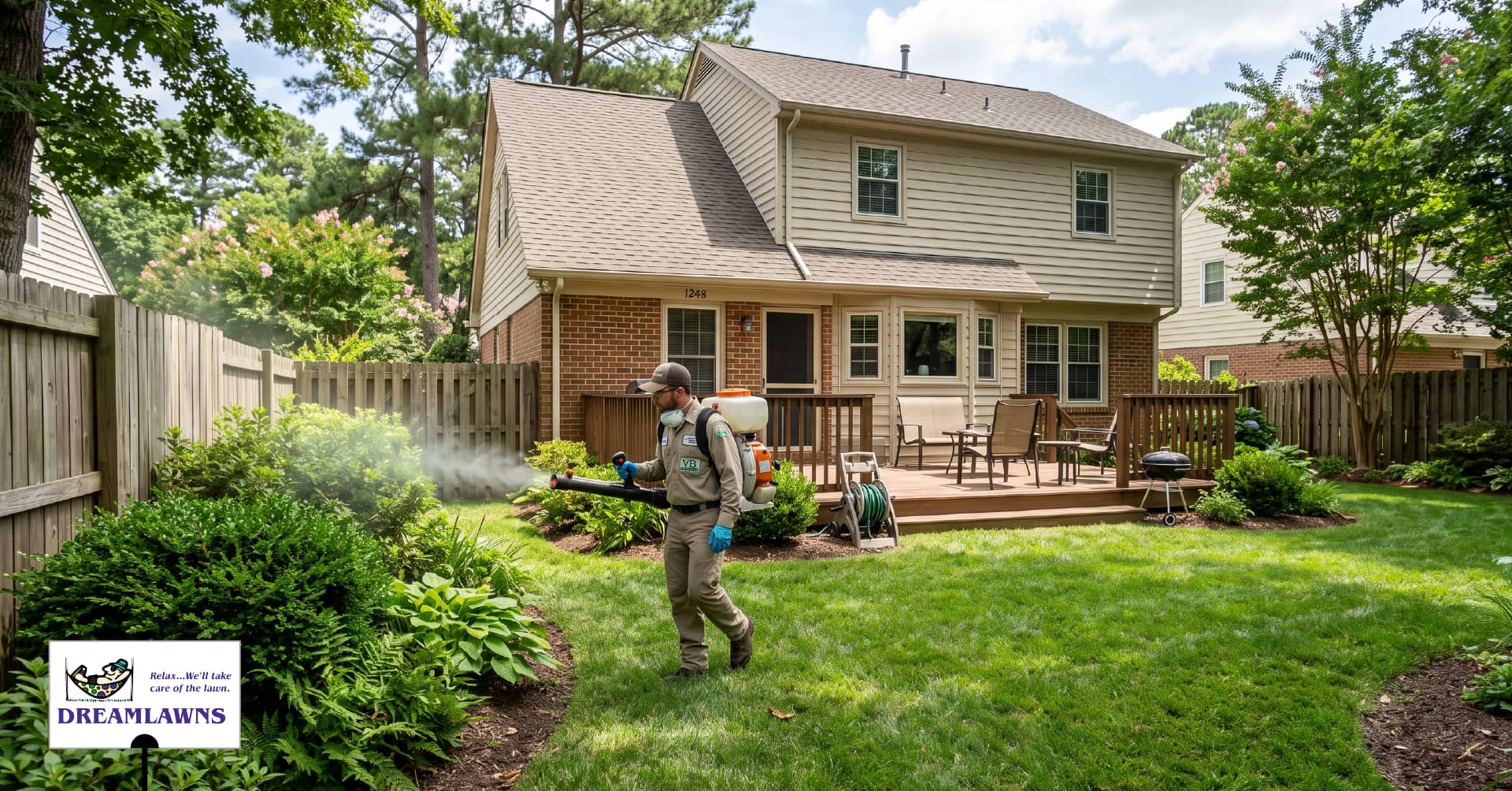
Barrier treatments are applied to the specific areas where adult mosquitoes rest during the day: the undersides of leaves, dense shrubs, tall grass, tree lines, and shaded ground cover. These treatments kill mosquitoes on contact and continue working as new mosquitoes land on treated surfaces. Sprays come in both conventional and organic formulations, giving homeowners options based on their preferences and priorities around pets, kids, pollinators, and surrounding landscape.
Mosquito stations take a different approach. Products like the In2Care station use a lure to attract female mosquitoes to a targeted breeding site, where they pick up a slow-acting larvicide and a fungus. The mosquito then spreads the larvicide to nearby breeding sites before dying, which breaks the reproduction cycle. Stations are particularly valuable on properties where preserving beneficial insects like bees and butterflies is a priority, since they target mosquitoes specifically rather than treating vegetation broadly.
Because mosquitoes reproduce quickly and new populations continually emerge and move in from surrounding areas, recurring treatment through the season is far more effective than a single application. Most effective programs treat on a recurring schedule of every few weeks, from early spring through late fall, maintaining consistent protection as treatments naturally break down and new mosquitoes arrive.
When Is Mosquito Season in Virginia Beach?
Mosquito season in coastal Virginia typically runs from spring through fall, and Virginia Beach’s mild climate tends to stretch that window longer than inland areas experience. Mosquitoes generally become active once temperatures are consistently above 50°F and remain active until the first sustained cold of late fall. The Virginia Department of Health notes that mosquito-borne disease cases usually peak in summer and early fall, when populations are at their highest.
The most important thing to understand about timing is that starting early matters. Beginning mosquito control before populations peak keeps numbers down all season, while waiting until mosquitoes are already swarming means playing catch-up against an established population. Dreamlawns’ mosquito programs run from late March or early April through October or early November to match the local season. Starting a recurring program at the front end of the window keeps populations down all season rather than playing catch-up against an established one.
How Does Dreamlawns Handle Mosquito Control in Virginia Beach?
At Dreamlawns, mosquito control starts with understanding your specific property, because every yard has its own combination of breeding sources and resting areas. Our outdoor pest control services include three mosquito programs designed to fit different property needs and homeowner preferences.
Mosquito Control Spray Program
A barrier treatment program with a choice of 7 conventional applications or 10 organic treatments, each providing up to 30 days of mosquito reduction. This is the standard, effective option for most properties.
Mosquito Station Program
A 7-treatment program that uses In2Care mosquito stations rather than broadcast sprays. The stations target mosquitoes specifically while minimizing impact on beneficial insects like pollinators. The program runs from late March or early April through October or early November and is priced monthly.
Mosquito Premium Program
Our most comprehensive option, combining 3 barrier sprays with 7 mosquito station services across a 7-treatment program. This layered approach maximizes mosquito reduction while still protecting beneficial insects, and it’s the right fit for homeowners who want the fullest possible protection.
Because coastal Virginia’s mosquito season stretches from early spring through late fall, all three programs are built as recurring services rather than one-off treatments. This is what maintains consistent protection as new mosquitoes emerge and treatments naturally break down.
Mosquitoes aren’t the only outdoor pest worth addressing. Dreamlawns also offers a Flea and Tick Control program with 4 blanket turf applications per year and a Perimeter Pest Control program with 4 applications per year that targets ants, spiders, and other crawling insects around the exterior of your home. For properties dealing with multiple pest pressures, these programs work well alongside mosquito control.
Explore our full range of outdoor pest control services to see how the programs fit together. Contact us today to schedule a property assessment. We’ll identify what’s driving your mosquito problem and recommend the program that fits your yard, your priorities, and your season.
Frequently Asked Questions
Most yard mosquito problems come from breeding sources on the property itself. Mosquitoes need only a small amount of standing water to reproduce, so clogged gutters, plant saucers, bird baths, low spots that pool after rain, and clogged drainage areas all contribute. Virginia Beach’s humid coastal climate, frequent rainfall, and nearby tidal marshes make the problem worse than in inland areas. Finding and eliminating standing water is the most effective first step. See the City of Virginia Beach resources for more on local mosquito conditions.
Professional barrier treatments are typically applied on a recurring schedule of roughly every few weeks during mosquito season. This is because the treatment naturally breaks down over time and because new mosquitoes continually emerge and move in from surrounding areas. A single treatment provides several weeks of protection, but maintaining low mosquito populations throughout the season requires recurring applications from spring through fall rather than a one-time spray.
Mosquito season in Virginia Beach typically runs from spring through fall, generally beginning once temperatures are consistently above 50°F and lasting until sustained cold arrives in late fall. The mild coastal climate tends to make the season longer than in inland Virginia. The Virginia Department of Health notes that mosquito activity and mosquito-borne disease risk peak in summer and early fall. Starting control early, before populations peak, keeps numbers down more effectively than waiting until mosquitoes are already swarming.
Lawn Care Services In The Virginia Beach Area
Dreamlawns provides superior lawn care service to Virginia Beach & Chesapeake VA residents.

