


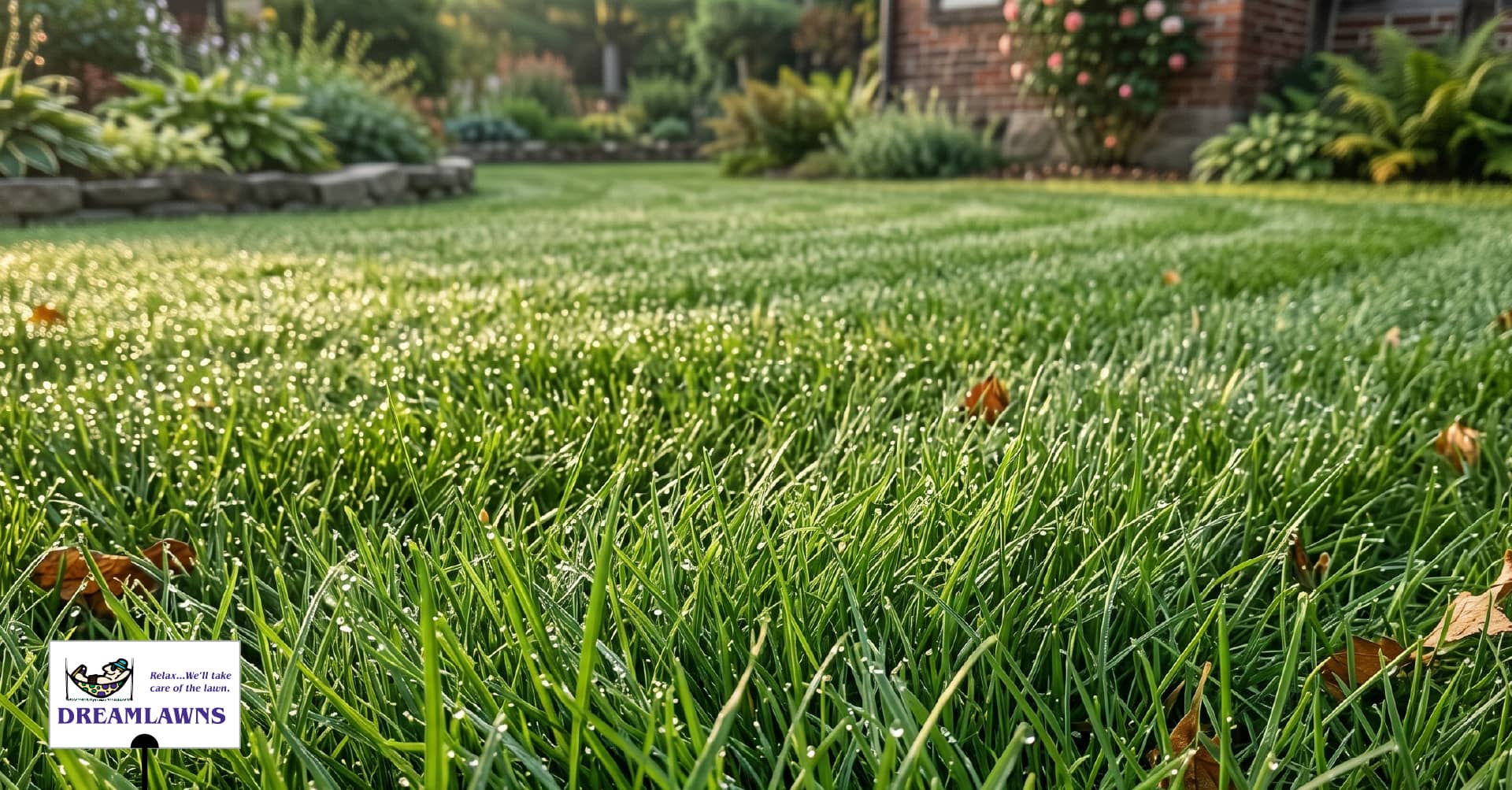
Dreamlawns Quick Cut: Pre-emergent herbicides work by stopping seeds from germinating, and they can’t tell the difference between a weed seed and the grass seed you want to grow. That’s why aggressive herbicide programs have to be scaled back or carefully timed as fall overseeding approaches. Applying pre-emergent too close to seeding sabotages the new grass before it even sprouts. Coordinating weed control and seeding is one of the most important, and most overlooked, parts of a successful fall lawn.
It’s natural to assume that more weed control is always better, and that a good lawn program means treating weeds whenever they appear. For most of the year, staying on top of weeds is exactly the right instinct. But for lawns being overseeded in the fall, a thoughtful lawn care approach has to adjust the timing of certain herbicides so they don’t work against the new seed.
This surprises a lot of homeowners. Why would you stop protecting the lawn from weeds right when you’re investing in making it thicker? The answer comes down to how pre-emergent herbicides actually work, and why applying them too close to seeding undermines the entire effort to build a denser lawn.
In this guide, we discuss why restraint and timing matter just as much as treatment. Understanding the conflict between herbicides and new seed, and why easing off at the right moment is the smarter move, is the key to a successful fall lawn. It also reflects a broader truth about good lawn care: knowing when not to spray is as important as knowing when to.
How Do Pre-Emergent Herbicides Actually Work?
To understand the conflict, you first have to understand how pre-emergent herbicides work. Unlike post-emergent products that kill weeds you can already see, pre-emergent herbicides work before weeds ever appear. They create a barrier in the top layer of the soil that stops germinating seeds from developing into established plants. When a weed seed sprouts and tries to push through, the pre-emergent stops it before it can take root.
Here’s the critical part: a pre-emergent barrier doesn’t distinguish between weed seeds and desirable grass seeds. It inhibits germination indiscriminately. The chemistry that stops a crabgrass seed from establishing works exactly the same way on a Fescue seed. The herbicide has no way to tell the difference between a weed you don’t want and the grass you’re trying to grow. To the pre-emergent, a seed is a seed.
This is why pre-emergent timing matters so much in general, as we cover in our guide on the life cycle of a weed. And it’s the entire crux of the conflict with overseeding. The very mechanism that makes pre-emergent effective against weeds makes it hostile to the new grass seed you want to establish.
Why Does Pre-Emergent Conflict With Overseeding?
Overseeding and pre-emergent herbicide are working toward directly opposite goals, which is why they can’t coexist in the same window.
Overseeding depends entirely on seeds germinating and establishing. You spread new grass seed, and success is measured by how much of it sprouts, roots, and fills in the lawn. Pre-emergent, on the other hand, is specifically designed to prevent seeds from germinating and establishing. Put the two together, and the pre-emergent barrier kills your new grass seed just as effectively as it would kill a weed. You’ve spent money on seed and preparation, only to have it stopped before it can grow.
At the soil level, this incompatibility is real: an active pre-emergent barrier will stop new seed from establishing in that same soil. That doesn’t mean weed control and seeding can’t both happen in the fall. It means they have to be timed and sequenced so they aren’t working in the same soil at the same time. As fall aeration and overseeding season approaches, that’s why pre-emergent timing has to be coordinated carefully around the seeding rather than applied on a rigid schedule. Put down too close to seeding, pre-emergent can undermine the very results you’re investing in.
Why Is This Especially Important for Fescue Lawns?
The herbicide-seeding conflict matters for any lawn being overseeded, but it’s a yearly reality for Fescue owners specifically. That’s because Fescue is a bunch-type grass that doesn’t spread to fill in bare spots, which means it must be overseeded every fall to stay thick. Unlike warm-season grasses like Bermuda, Zoysia, and St. Augustine, which spread on their own and aren’t overseeded annually, Fescue faces this timing conflict every single year.
What makes it especially tricky is that fall is prime season for both goals at once. Fall is when winter weeds germinate, making it the ideal window for pre-emergent weed prevention. But fall is also the only good window for overseeding Fescue, since new seed needs the cooling temperatures to establish before winter. The two most important fall lawn tasks for a Fescue owner, preventing winter weeds and thickening the lawn through overseeding, collide directly on the calendar.
This collision is exactly why Fescue lawns need a coordinated plan rather than a spray-on-schedule approach. Handle the timing thoughtfully, and you can accomplish both goals in sequence. Handle it carelessly, applying pre-emergent and then seeding a few weeks later, and you waste the seed, the weed control, or both.
It’s worth being clear about how this shapes winter weed control on Fescue, because it fits with how these lawns are managed the rest of the year. Because pre-emergent and new seed don’t mix, and because pre-emergents can interfere with actively growing Fescue in general, Fescue lawns typically rely on selective post-emergent suppression to manage winter weeds rather than pre-emergent barriers. That approach controls weeds without working against the fall overseeding. Warm-season lawns are a different situation entirely: they aren’t overseeded in the fall, so their fall pre-emergent applications for winter weeds proceed right on schedule, with no seeding conflict to work around. In other words, easing off pre-emergent is specific to lawns being overseeded, not a reason to skip fall weed control across the board.
How Long Do You Have to Wait to Seed After Herbicide?
This is the practical question homeowners ask most, and the honest answer is: it depends on the specific product. There is no single universal waiting period, because different pre-emergent herbicides have very different soil residual periods, the length of time the barrier stays active in the soil.
Some pre-emergents break down relatively quickly and allow seeding after a matter of weeks. Others remain active in the soil for several months, meaning a spring application can still interfere with fall seeding if the wrong product was used. A handful of products are specifically formulated and labeled as safe for seeding sooner, but most standard pre-emergents are not. The waiting interval can range anywhere from a few weeks to several months depending entirely on which herbicide was applied and at what rate.
This is precisely why the product label and professional knowledge matter so much here. Getting it wrong in either direction is costly: seed too soon after a long-residual pre-emergent and the new grass fails, or wait unnecessarily long and you miss the optimal seeding window. Matching the herbicide choice and timing to the overseeding plan, rather than treating them as separate decisions, is where careful coordination earns its value.
What About Weeds During Overseeding Season?
To be clear, easing off pre-emergent in the seeding window doesn’t mean abandoning fall weed control. Lawns that aren’t being overseeded keep their normal fall weed prevention, and Fescue lawns still manage winter weeds through selective post-emergent suppression. For a lawn that is being overseeded, it means accepting a brief, targeted compromise on pre-emergent in the seeded areas during the establishment window. It’s a fair question whether that trade-off is worth it, and in almost every case it is. Here’s why.
The single best long-term defense against weeds isn’t herbicide at all. It’s a thick, healthy lawn. Dense turf physically crowds out weeds, shading the soil and denying weed seeds the light and space they need to establish. When you overseed to build a denser lawn, you’re investing in the most durable weed control there is. A brief pause on pre-emergent to allow that overseeding to succeed pays off in a lawn that suppresses weeds naturally for seasons to come. The short-term compromise buys long-term weed resistance through density.
There’s a related consideration with post-emergent herbicides, which kill weeds that are already growing. Young, newly germinated grass seedlings are sensitive to many post-emergent products, so weed treatments generally have to wait until the new grass is established, often until it’s been mowed a few times. This is another reason the overseeding window calls for herbicide restraint.
How Do You Balance Weed Control and Seeding in the Fall?
Balancing weed control and overseeding isn’t about choosing one and abandoning the other. It’s about sequencing them thoughtfully so both goals are served. This is fundamentally a coordination problem, not a spray-more problem, and there are several ways to solve it.
- Time the sequence deliberately: Either apply pre-emergent early enough that its residual clears before seeding, or seed first and delay pre-emergent until the new grass is established. Which approach fits depends on the specific lawn and products.
- Choose products around the seeding plan: Herbicide selection should account for the overseeding schedule from the start, rather than seeding being treated as an afterthought to a fixed spray program.
- Prioritize based on the lawn’s needs: A lawn with heavy weed pressure and decent density may lean toward weed control, while a thin lawn that desperately needs seed may prioritize overseeding and accept a temporary weed compromise.
- Protect the new seedlings: Hold off on post-emergent weed treatments until the new grass is established enough to tolerate them, typically after it’s been mowed a few times.
- Plan the whole fall as one program: Weed control, aeration, overseeding, and fertilization should be planned together as an integrated sequence, not applied as isolated treatments that may work against each other.
Handled this way, a Fescue lawn can get both effective weed prevention and successful overseeding in the same fall. The key is that the whole program is designed as a coordinated plan from the outset.
Why This Reflects a Smarter Approach to Lawn Care
Easing off herbicides at the right time isn’t doing less. It’s doing what’s right for the lawn. And it reflects a broader philosophy about how lawn care should work.
A program that applies pre-emergent on a rigid calendar schedule without accounting for whether a lawn is being overseeded can work directly against that overseeding. The issue isn’t weed control itself, which remains essential, it’s treating weed control and seeding as separate, unrelated tasks when they’re actually connected parts of one fall plan. On a lawn slated for overseeding, applying pre-emergent without adjusting for the seeding can quietly undermine the very result the homeowner is paying for.
A thoughtful, science-based approach treats the whole lawn as a system. It recognizes that the goal isn’t to apply the most treatments, it’s to build the healthiest, thickest lawn, and that sometimes the right move is to hold off on a treatment so a more important one can succeed. Knowing when not to spray is a mark of expertise, not a gap in service. It’s the difference between a program built around products and a program built around results.
How Does Dreamlawns Coordinate Weed Control and Seeding?
At Dreamlawns, weed control and overseeding are never treated as separate, disconnected tasks. Our fertilization and weed control program is planned around the overseeding schedule, so herbicide timing and product selection support the fall seeding rather than sabotaging it. We sequence the fall program deliberately, weed prevention, aeration, overseeding, and fertilization, so each step works with the others instead of against them.
This coordination is exactly the kind of thing a professional program handles that do-it-yourself approaches so often get wrong. A homeowner applying a store-bought pre-emergent in early fall and then seeding a few weeks later, unaware of the product’s residual period, is one of the most common and costly overseeding mistakes we see. Knowing the intervals, choosing the right products, and timing everything to the overseeding plan is where careful expertise makes the difference. And because our aeration and overseeding service is built to create a dense lawn, the long-term result is turf that suppresses weeds naturally, reducing the need for aggressive herbicide in the first place.
Contact us today to schedule a property assessment. We’ll build a coordinated fall plan that gets your lawn both the weed protection and the overseeding it needs, in the right order.
Frequently Asked Questions
No. Pre-emergent herbicides create a barrier that stops seeds from germinating, and they can’t distinguish between weed seeds and desirable grass seed. Applying them together means the pre-emergent kills your new grass seed just as it would a weed, wasting the seed and the effort. The two work toward opposite goals and can’t be used in the same window, so weed prevention and seeding have to be sequenced deliberately. This applies to lawns being overseeded. Lawns that aren’t being seeded, including warm-season lawns getting fall pre-emergent, follow their normal weed control schedule.
It depends entirely on the specific product. Different pre-emergent herbicides have very different soil residual periods, ranging from a few weeks to several months. Some products are labeled as safe for seeding sooner, but most standard pre-emergents remain active long enough to interfere with germination for a significant period. Always check the specific product’s label for its seeding interval, or work with a professional who knows the intervals, since seeding too soon after a long-residual product causes the new grass to fail.
Pre-emergent weed killers absolutely will stop grass seed from growing, because they’re designed to prevent seed germination and can’t tell desirable grass seed from weed seed. Post-emergent weed killers, which target growing weeds, are a different matter, but they can still damage young grass seedlings, so weed treatments generally have to wait until new grass is established. Either way, herbicide timing has to be coordinated carefully with seeding, or the new grass suffers.
Yes, significantly, over time. A thick, dense lawn is the single best long-term defense against weeds, because dense turf physically crowds out weeds and shades the soil, denying weed seeds the light and space they need to establish. Overseeding builds that density. So while you may pause herbicide during the overseeding window, the thicker lawn that results suppresses weeds naturally for seasons afterward. This is why easing off herbicide to allow successful overseeding is a worthwhile trade: you’re investing in the most durable weed control there is.
Lawn Care Services In The Virginia Beach Area
Dreamlawns provides superior lawn care service to Virginia Beach & Chesapeake VA residents.

