


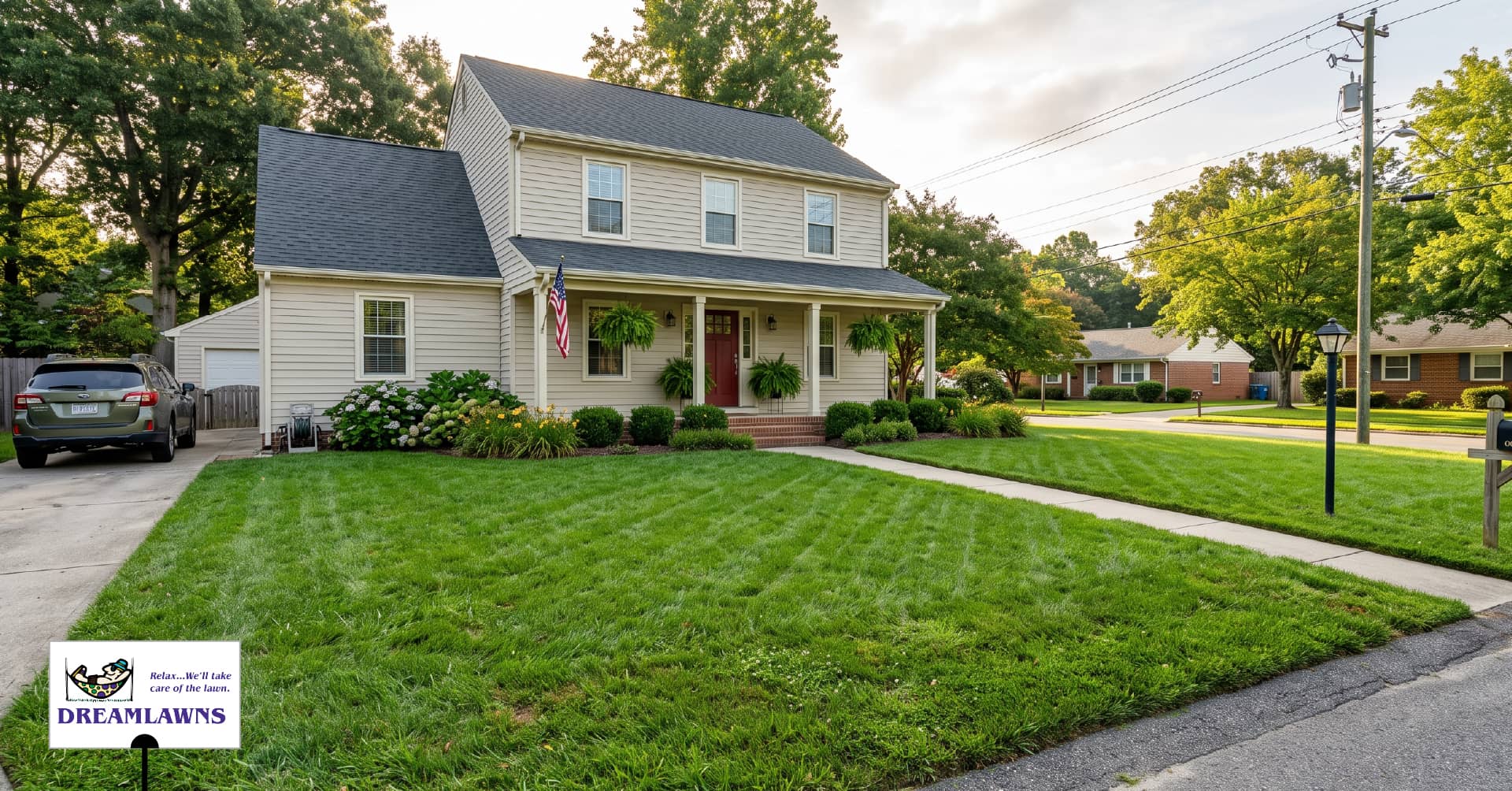
Dreamlawns Quick Cut: If your lawn seems to be growing slower in late summer, that’s completely normal. As temperatures ease off their summer peak and the days grow shorter, grass growth naturally slows. For warm-season grasses like Bermuda and Zoysia, it’s the beginning of the gradual slowdown toward fall dormancy. For Fescue, it’s the tail end of summer stress just before its best growing season returns. Understanding what’s happening helps you shift your care to match the season ahead.
You’ve been mowing all summer, and then you start to notice it. You’re mowing a little less often, the grass isn’t bouncing back the way it did in June, and growth just seems to be tapering off. For a lot of Virginia Beach homeowners, this is the moment they start to wonder whether something is wrong with the lawn.
In most cases, nothing is wrong at all. A late-summer slowdown is one of the most normal and predictable things a lawn does. Grass growth rises and falls with the seasons, and as summer begins to wind down, that growth naturally eases off for reasons that are completely healthy and expected.
Understanding why this happens, and what it means for the weeks ahead, takes the worry out of it and helps you adjust your care for the season to come. This guide explains what’s behind the late-summer slowdown, how it looks different depending on your grass type, and why it’s actually a signal that the most important season for your lawn is just around the corner.
Why Does Grass Growth Slow Down in Late Summer?
Grass growth is driven mainly by temperature, with day length and moisture playing supporting roles. Every grass has a temperature range where it grows best, and growth slows as conditions move away from that range. In late summer, a couple of things shift at once, and the result is the slowdown you’re seeing.
- Temperatures move off their summer peak: Temperature is the primary driver of how fast grass grows, and as the extreme heat of mid-summer begins to ease, growth rates change in response. For warm-season grasses that thrive in peak heat, cooling conditions mean slowing down. Soil temperature matters even more than air temperature here, since the roots and growing points sit at or just below the surface, and soil temperature changes more gradually than the daily air temperature does.
- The days grow shorter: After the summer solstice in June, daylight hours gradually decrease. Less daylight means fewer hours of photosynthesis, which contributes to slower growth. This is a supporting factor rather than the main driver, but it plays a real role, especially in signaling warm-season grasses to begin preparing for dormancy.
These factors work together, and their effect depends heavily on what type of grass you have. The same late-summer conditions that tell a warm-season lawn to start winding down are the conditions that tell a cool-season lawn its best season is coming.
Is Slow Growth in Late Summer a Bad Sign?
In the large majority of cases, no. A gradual slowdown in late summer is expected seasonal behavior, not a warning sign. Grass isn’t meant to grow at the same explosive rate all year long. Its growth naturally rises and falls with the seasons, and a late-summer taper is simply part of that rhythm.
Normal seasonal slowdown has a recognizable character. It’s gradual rather than sudden, it’s fairly uniform across the lawn rather than showing up in isolated patches, the grass still looks green and healthy even as it grows more slowly, and the timing matches the season. If your lawn fits that description, the slowdown is almost certainly just the calendar doing its work.
The less frequent mowing that comes with it is genuinely a good thing, not a sign of failure. It means less work for you and a lawn that’s shifting its energy in healthy, season-appropriate ways. That said, there are cases where slow or stalled growth signals a real problem rather than a seasonal one, and we’ll cover how to tell the difference later in this guide.
What’s Happening to Warm-Season Grasses in Late Summer?
For warm-season grasses, Bermuda, Zoysia, and St. Augustine, late summer marks the beginning of the long, gradual wind-down toward winter dormancy. These grasses do their best growing in the peak heat of summer, when daytime temperatures sit in the 80s and 90s. As that peak passes and temperatures begin to ease, their growth naturally starts to slow.
Something important is happening beneath the surface during this slowdown. As the days shorten in late summer, warm-season grasses begin shifting their energy from active top growth toward storing carbohydrate reserves in their roots and crowns. Those stored reserves are what will carry the grass through winter dormancy and fuel a strong green-up next spring. So even though you’re seeing less growth above ground, the plant is doing exactly the right thing to prepare for the months ahead.
This is a completely healthy and necessary transition. Warm-season grasses will continue to slow through fall and eventually go fully dormant and brown once temperatures drop consistently, generally when they fall into the 50-to-55-degree range depending on the grass. The late-summer slowdown is simply the first stage of that natural process, and it’s a cue to begin adjusting care toward pre-dormancy preparation rather than pushing more growth.
What’s Happening to Fescue in Late Summer?
For Tall Fescue, the story is completely different, and it’s good news. Fescue is a cool-season grass, which means it grows best in the milder temperatures of spring and fall, roughly the 60-to-75-degree range, not in summer heat. Through the peak of summer, Fescue isn’t thriving. It’s enduring. Its growth has been suppressed by exactly the heat, humidity, and stress it likes least.
So for Fescue, a late-summer slowdown often isn’t really a fresh slowdown at all. It’s the tail end of a summer-long struggle. The grass has been stressed and likely thinned by heat and disease, and its sluggish growth reflects that. If your Fescue looks tired and slow in August, it’s been through a lot, and that’s normal for the season.
Here’s the encouraging part: for Fescue, this moment is the doorway to its best season. As temperatures cool through late summer and into fall, and as soil moisture becomes more reliable, Fescue’s growth resumes, and it enters its strongest growing period of the entire year. The late-summer lull is the last stretch before recovery. Rather than a decline, it’s the quiet before Fescue’s comeback, which is exactly why fall is the critical season for cool-season lawns in Virginia Beach.
How Should You Adjust Lawn Care as Growth Slows?
The late-summer slowdown is a natural cue to shift your lawn care for the season ahead. Here’s how to adjust as growth eases off.
- Mow less often, but keep the height right: As growth slows, you’ll naturally mow less frequently. Keep mowing at the correct height for your grass type rather than cutting low, and never scalp. Removing too much leaf surface when growth is slowing stresses the lawn just when it’s trying to store energy.
- Keep the mower blade sharp: A sharp blade makes a clean cut that the grass recovers from more easily, which matters more as the lawn slows and heals more slowly.
- Adjust your watering: As temperatures ease and evaporation drops, your lawn needs less supplemental water than it did at the height of summer. Keeping a peak-summer watering schedule into late summer can lead to overwatering. Water deeply and infrequently, and account for cooler, wetter conditions.
- Stay alert for late-summer disease: Cooler nights combined with lingering humidity and heavy dew create a disease window, especially for Fescue. Slower growth plus disease pressure is worth watching closely.
- Start planning fall care: The slowdown is your signal that fall is coming. For Fescue, that means planning aeration and overseeding. For warm-season grasses, it means preparing for dormancy. Getting ahead of these now sets the lawn up for success.
How Do You Tell Normal Slowdown From a Real Problem?
While late-summer slowdown is usually just the season at work, it’s worth knowing how to tell the difference between a healthy taper and a genuine problem, so reassurance doesn’t cause you to overlook something that needs attention.
Signs of Normal Seasonal Slowdown
- Growth eases off gradually rather than stopping suddenly
- The change is fairly uniform across the whole lawn
- The grass still looks green and healthy, just growing more slowly
- The timing matches the season, late summer moving into fall
Signs Something Else May Be Going On
- Sudden browning or patches that appear quickly rather than a gradual, even slowdown
- Thinning or dead spots that don’t match a uniform pattern
- Circular patches, discoloration, or other signs of disease
- Turf that lifts easily from the soil, which can indicate grubs or other pests
If what you’re seeing looks less like a gentle, even slowdown and more like something is actively wrong, it’s worth investigating. Our guides on why your lawn is turning brown and drought stress versus heat stress can help you sort out whether you’re looking at normal seasonal change or a problem that needs a response.
Why Late Summer Is the Time to Prepare for Fall
The most useful way to think about the late-summer slowdown is as a signal. It’s the lawn telling you that the seasons are changing and that fall, the most important season for lawn care in Virginia Beach, is approaching. Rather than a cause for worry, it’s a cue to get ready.
For Fescue owners, that cue matters a great deal. Fall is when Fescue recovers from summer and rebuilds the density it lost, and the key to that recovery is aeration and overseeding, which needs to be planned and scheduled ahead of the mid-September to mid-October window. The late-summer slowdown is your reminder that this window is coming and that now is the time to plan.
For warm-season grass owners, the slowdown signals that it’s time to shift toward pre-dormancy preparation, supporting the lawn as it stores energy for winter and readies itself for a strong spring green-up. Either way, the homeowners who read the late-summer slowdown as a starting gun rather than a warning bell are the ones whose lawns come through the transition strongest.
How Does Dreamlawns Help Your Lawn Through the Seasonal Transition?
At Dreamlawns, we build lawn care around the natural growth cycles of each grass type, which is exactly what the late-summer slowdown is all about. Understanding whether your lawn is beginning its wind-down toward dormancy or gearing up for its best season is the foundation of getting the timing right on everything that follows.
That means we adjust care as growth slows, easing off in the right ways, watching for the late-summer disease pressure that accompanies the transition, and timing fall treatments to match what each grass actually needs. For Fescue lawns, we coordinate the aeration, overseeding, and fertilization that drive fall recovery. For warm-season lawns, we guide the transition toward dormancy so the grass stores the energy it needs for a strong spring.
The goal is a lawn that moves through each seasonal transition smoothly, cared for in a way that matches what it’s actually doing rather than fighting against its natural rhythm. Contact us today to schedule a property assessment and make sure your lawn is set up for a strong fall and beyond.
Frequently Asked Questions
Grass growth is driven mainly by temperature, and as the peak heat of summer begins to ease, growth naturally slows. Shorter days after the June solstice also contribute by reducing the hours of sunlight available for photosynthesis. For warm-season grasses like Bermuda and Zoysia, this is the start of their gradual slowdown toward fall dormancy. For cool-season Fescue, slow late-summer growth reflects the lingering stress of summer heat, with recovery coming as fall cools things down. In almost all cases, a gradual late-summer slowdown is completely normal.
Slowing significantly in August is normal, though most Virginia Beach lawns don’t fully stop growing until later. Warm-season grasses gradually slow as temperatures ease and days shorten, eventually going dormant when temperatures drop into the 50-to-55-degree range in fall. Fescue slows under summer stress and then picks back up as fall arrives. A gradual, even slowdown that keeps the grass green is normal seasonal behavior. Sudden browning, patches, or thinning that don’t fit an even pattern are worth investigating.
Warm-season grasses like Bermuda and Zoysia grow best in peak summer heat, so as late-summer temperatures begin to ease and the days shorten, they naturally slow down. This is the beginning of their gradual transition toward winter dormancy. During this slowdown, the grass shifts its energy from top growth toward storing carbohydrate reserves in its roots and crowns to fuel winter survival and spring green-up. It’s a completely normal and healthy part of the warm-season growth cycle, not a sign of a problem.
Almost never. Slow growth in late summer is a normal seasonal response, not a sign of a dying lawn. A healthy slowdown is gradual and even, and the grass stays green while simply growing more slowly. Warm-season grasses are storing energy for winter, and Fescue is waiting out the last of summer before its fall recovery. A lawn that’s actually in trouble tends to show sudden browning, patchiness, or thinning that doesn’t match an even, gradual pattern.
Lawn Care Services In The Virginia Beach Area
Dreamlawns provides superior lawn care service to Virginia Beach & Chesapeake VA residents.

